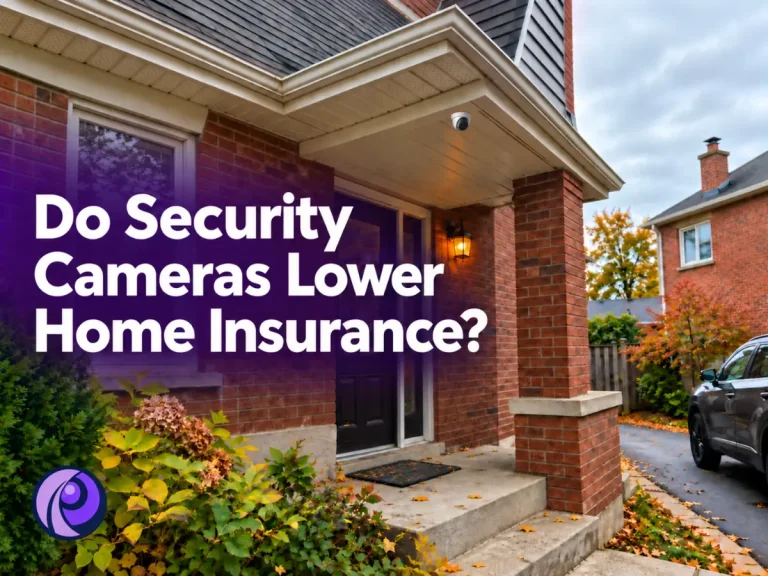
Do security cameras lower home insurance? People ask it on almost every quote we give. On their own, cameras rarely do. Most Canadian insurers save their discount for a monitored alarm. Cameras pay you back in a different way, when something goes wrong and you need to prove what happened. If the cameras protect a business or a rental property, there’s a tax side to consider as well.
We plan and install camera systems across Toronto and the GTA, so we hear the money questions constantly. Below you’ll find what insurers look for, what the Canada Revenue Agency (CRA) allows, and where online answers written for the US market steer Canadian owners wrong. If you’re still weighing whether a system is worth it, our security camera installation page covers what a professional install includes.
The short answer
Cameras alone rarely earn a home insurance discount in Canada. The discounts brokers quote, typically somewhere between 5% and 20%, usually go to professionally monitored alarms, though some insurers now credit app-connected smart home systems. Cameras pay off at claim time instead, and for businesses and landlords the cost can be claimed for tax purposes, usually as Class 8 equipment.
Do Security Cameras Lower Home Insurance in Canada?
Does having security cameras lower insurance on its own? Rarely, and the reason is simple. Insurers price risk, and what they reward is anything that stops a loss, or shrinks it while it’s happening. A camera records a break-in. A monitored alarm calls someone during it. That difference is why the discount usually follows the alarm. A spokesperson for the Insurance Bureau of Canada has said that most property insurance applications ask whether a home has a monitored alarm, while camera systems often aren’t asked about at all.
| What you have | How insurers usually treat it | Proof they may ask for |
|---|---|---|
| Cameras only, self-monitored on your phone | Rarely a dedicated discount. Some insurers credit app-connected smart home systems, so it’s worth asking | Model numbers and installation date |
| Local alarm (siren only, no monitoring) | A smaller discount, if any | Description of the system |
| Professionally monitored burglar alarm | The main security discount; broker-quoted ranges run from about 5% to 20% | Monitoring certificate and an active contract |
| Monitored fire, smoke or water-leak sensors | Can earn an additional credit; TD, for example, offers savings for leak detection | Monitoring certificate or device details |
Those percentages vary a lot by insurer, province and premium size, so treat them as a reason to ask, not a promise. On a $1,500 annual premium, a 10% discount is $150 a year.
If lowering your premium is the main goal, the alarm does the work and the cameras add the evidence. An alarm from DSC or Ajax, connected to a monitoring company you choose, is the kind of system insurers ask about. Cameras alongside it let you see what triggered the alarm before deciding whether to call the police.
Security Camera Insurance Discount: How to Get It
A discount doesn’t apply itself. If your insurer doesn’t know about the system, it can’t credit you for it. Four steps make sure you’re credited:
- Ask before you buy. Call your insurer or broker and ask which systems qualify: monitored only, or app-connected self-monitoring too? Do cameras count on their own? Do water sensors earn a separate credit? If monitoring is required, does the monitoring centre have to be ULC listed (the Canadian standard insurers typically reference)?
- Keep the paperwork. Save the installation invoice and model numbers. For a monitored alarm, ask the monitoring company for a monitoring certificate, since insurers may ask for one.
- Update your policy. Tell your insurer the system is installed. Some, like TD Insurance, let you add it online to your dwelling details; others need a call.
- Check at renewal. Make sure the credit still shows on your renewal. If you switch monitoring companies, send the new certificate.
Where Cameras Really Pay Off: Claims, Not Premiums
The biggest financial return from cameras tends to arrive after a loss. Clear footage can make a claim faster and harder to dispute: it shows when a break-in happened, what was taken, how someone got in, and which vehicle they left in. It can also help with liability claims, like a slip on your walkway or damage a contractor denies causing.
For footage to help, a few details matter more than resolution. Cameras need to cover the doors and the driveway, the recording has to still exist when the adjuster asks for it, and the timestamp has to be right. A recorder that’s an hour off after the clocks change raises doubts, and our guide to fixing NVR timestamps covers that. For houses, placement is where most systems succeed or fail, and it’s the core of every residential security camera installation we plan.
Does CCTV Lower Insurance for a Business?
Commercial insurance is underwritten case by case. The insurer looks at the whole risk: the kind of business, the location, the claims history, and the security in place. So a business insurance security camera discount is something to ask your broker about, not something to assume.
The bigger risk on a business policy is a clause many owners don’t read. Some property policies include a burglar alarm warranty, which requires the alarm to be fully connected, operational and certified during off-hours. If a break-in happens while the system is offline, the insurer can refuse the theft claim. For a business, then, the job is less about chasing a discount and more about protecting the coverage you already pay for:
- Read your policy for alarm or protective safeguards conditions, and ask your broker what they require.
- Keep the alarm and cameras maintained, and fix faults quickly. A camera that’s been offline for weeks is the one you’ll need.
- Keep service records. They show the insurer the system was working when it mattered.
Our commercial security camera installation work covers retail, offices, restaurants and industrial sites, and we document each system so the details are easy to share with your broker.
Can I Write Off Security Cameras in Canada?
Search for this and most results are written for the US, with IRS rules and US tax forms. In Canada, the answer depends on who owns the cameras and what they protect. Cameras on your own home, used for personal reasons, aren’t deductible. Business and rental use is where it changes.
| Your situation | Can you claim it? | How |
|---|---|---|
| Cameras on your own home, personal use | No | Not a deductible personal expense |
| Home-based business | Partly | Business share of the cost, based on the space used for the business |
| Rental property you own | Yes | Capital cost allowance (CCA), with limits |
| Business premises | Yes | Capital cost allowance (CCA); monitoring fees are a regular expense |
Home-based business
The CRA allows business-use-of-home expenses on Form T2125 in two cases: your home is your principal place of business, or you use part of it only for business and regularly meet clients there. The usual approach is to claim the business share of the cost, based on the business space as a percentage of the home.
Rental property
Landlords can claim cameras installed at a rental property through capital cost allowance. The key CRA rule to know: CCA can’t be used to create or increase a rental loss, so it only reduces rental income that’s already positive. How much you can claim in the first year depends on when the system was bought and put into use, because accelerated CCA rules currently apply to most new equipment.
CCA class for security cameras
The CRA’s class list doesn’t name security cameras specifically, so a camera system generally falls into Class 8, the 20% class for equipment not included in another class, with installation labour added to the cost. Three related points:
- Monitoring fees are a regular operating expense, deducted in the year you pay them, not depreciated.
- GST/HST registrants can generally claim input tax credits on the GST/HST paid when the system is used primarily in their commercial activities.
- First-year claims are boosted. Under the accelerated investment incentive, equipment put in use before 2028 skips the usual half-year limit. For Class 8, that means a first-year claim of 20% instead of 10%.
This is general information, not tax or insurance advice. Rules change, and your accountant or broker can confirm how they apply to you.
Planning a System With Insurance and Taxes in Mind?
A camera system that’s placed well, records reliably and keeps its paperwork in order is the one that pays you back at claim time and at tax time. We’ll design it around your property, document it for your insurer or accountant, and set it up so the footage holds up when you need it. Book a free on-site assessment or call us. We work across Toronto, North York, Markham, Vaughan, Mississauga and the rest of the GTA.